








BY ROBIN GHOSH
(ECONOMIST, PRESIDENT OF SHANTINIKETAN SOCIETY FOR YOUTH EMPOWERMENT)
KOLKATA , 29 APRIL 2023:
Seldom do you have a chance to read a fascinating novel and at the same time meet the author.
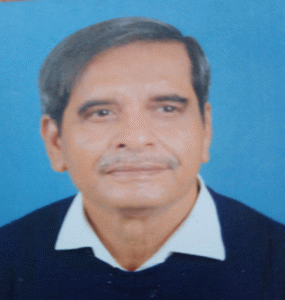
This is what happened to me recently when I was fortunate to meet Asoke Bhattacharya.
Prof. Asoke Bhattacharya has been researching modern Philosophy and the Danish Folk High School Movement since the 1980s.
Fredrik Nagar: the story of the Birth of Indian Renaissance at the Danish Colony of Serampore.
The Danish enclave called Fredericks Nagore, also known as Serampore, now in West Bengal, India, was the seedbed of the Indian Renaissance.
In the foreword of the book Prof. Asoknath Basu formerly Vice Chancellor, Jadavpur University writes :
“Here, defying the dictates of the British colonialists, the kuthi Chief Ole Bie, provided shelter to the Baptist missionaries. And here William Carey, in collaboration with Ramram Basu, created the modern Bengali prose. The missionaries also founded the Serampore College, the first University in Asia (1818), having received the royal charter from the Danish monarch Frederick VI (1827). The novel has been written against the backdrop of these epoch-making events.

There is a great tradition of historical novel writing in Bengal. It started with the legendary Bankim Chandra Chattopadhyaya whom the British called the ‘Scott of Bengal’. He was followed by Ramesh Chandra Dutta, Rakhaldas Bandyopadhyay, Hara Prasad Shastri, Narayan Gangopadhyay, Pramathanath Bishi and finally, Saradindu Bandopadhyay. All these writers followed the Western style of historical novel writing, though many of them wrote on absolutely Indian themes. Asoke, in my opinion, had dealt withboth Indian and Western themes but his style of presentation is oriental in nature and this I consider a new contribution to this genre of literature.

All architectures mentioned in this novel including the churches, institutions, schools, colleges, hospitals etc., chronology of major events, the printing press, the translation of the Bible in different languages, cities and ports like Fredericksnagore, Tranquebar, as well as Calcutta, Colombo, Aden Cape of Good Hope, London, Copenhagen etc. are facts. There are many other facts of the past society and polity present in this fiction. All these facts are real and these the author has miraculously woven into a surreal tapestry. Full of romance, intrigue, fear, love and hatred, this novel turns out to be a human document of a historical period of Bengal spanning the late eighteenth century and the first quarter of nineteenth century. It was as Charles Dickens described in his famous novel ‘A Tale of Two Cities’, the best of times and the worst of times in India under colonial subjugation.
During this period, Bengali prose was overcoming its adolescence; newspapers like the Samachar Darpan were contributing immensely to Indian culture and education. The combined efforts of the Danes, the English and the Bengalis like Ramram Basu, Mrityunjay Tarkalankar etc. were lifting Indian languages, and specifically, the Bengali language to a new height of finesse. A process of acculturation was taking place in Indian society. The novel depicts this process of assimilation in vivid details.

Then we come across the founding of the first university of Asia, the Serampore College. It was focused on a futuristic democratic and secular India where diverse races would mingle to give shape to an enlightened nation. The novel proclaims its forthcoming”.
Incidentally, the book is available from Hindustan Publishing Company, 15, Bankim Chatterjee Street, Kolkata 700 003 and the ISBN No. 978-81- 927763-9-2
Enjoy the Novel. It is indeed fascinating.
This novel is a milestone in the cultural history of the Indo Danish relationship

Advertisement:

















Add Comment