





By PRASHANT KUMAR MISHRA
( EX GM, MODERN COACH FACTORY, RAEBARELI & RAIL COACH FACTORY, KAPURTHALA)
MUMBAI | 11 APRIL 2026
In the early years of the East Indian Railway Company, the first challenge to the iron road was not the jungle, nor the mountain, but the river.
Between Calcutta and Howrah lay the Hooghly—broad, tidal, and, in those days, without a bridge. The railway terminated on one bank; the life of the city pulsed on the other. To travel by train, one had first to entrust oneself to the river.
The crossing, at first, depended on country boats—fragile craft at the mercy of current and weather. So hazardous was the passage that the railway avoided running services after sunset, unwilling to trust the river in darkness.
Steam and Certainty:
The introduction of steam ferries, named “Howrah” and “Calcutta” in 1856 marked a decisive shift.
“The Indian News” proclaimed their launch on January 15, 1856: “The Railway Company’s steam ferry boat is to be launched from the Howrah Docking Company’s Yard on Monday.”
These fairies brought the river within the order of the timetable. Their departures were fixed; their arrivals predictable.
Passengers could now consult their schedules (like the EIR timetable of 1862, which advertised crossings at 7:20 AM, 8:10 AM, 10:40 AM, 3:40 PM, and 5:20 PM) and expect to traverse the river in a mere twenty minutes. J. Powell, the first Commander at Howrah, steered these vessels not only with passengers but, occasionally, with vital railway materials destined for the interior.
A single ticket now covered both the watery passage and the onward rail journey. What was once a debilitating break in the journey became a seamless continuation—a pioneering “multimodal system” that stitched together land and water, effectively disciplining the mighty Hooghly.
The River as Obstacle—and Opportunity:
Yet the Hooghly was only the beginning. Beyond lay the vast river system of northern India— the Ganges and its tributaries—unbridged, shifting, and often shallow.
At the same time, Calcutta became a depot of accumulation. Ship after ship discharged rails, chairs, sleepers, locomotives—hundreds of thousands of tons destined for the interior. To move them inland was a problem that defied conventional means.
Private river transport proved unreliable. Captains, wary of sandbanks, imposed restrictions on loading. Delays multiplied. Materials lay idle, and the progress of the railway faltered.
The difficulty was not of engineering the track, but of feeding it. 1857: The Flotilla at War
The first war of Independence of 1857 transformed this logistical apparatus into an instrument of war.
Every available vessel—steamers, flats, country boats—was commandeered by East India Company. Troops, guns, and stores were conveyed rapidly across regions where roads had dissolved into mud and distance into uncertainty.
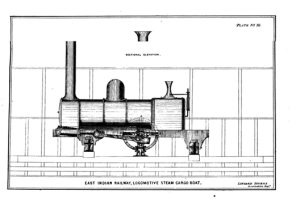
Locomotive engines, lying idle for want of track, were mounted upon flat-bottomed boats by Locomotive Superintendent of EIR and pressed into service as marine power. Vessels such as the Sir Henry Lawrence carried soldiers upstream, their machinery drawn directly from the workshops of the railway.
Yet the consequences were double-edged. The same system that enabled rapid military movement also diverted resources from construction. Materials accumulated. Progress slowed. The railway, still in its infancy, found itself dependent upon the very river it sought to overcome.
The Audacious Decision: Command the River Faced with this grinding impasse, the Company made an audacious decision. Mr. Rendel, the
Consulting Engineer for the East Indian Railway, was dispatched to India in 1858. His mission: to review the stagnant railway construction and propose a radical solution. Following intense discussions with key figures—Mr. Palmer, the Agent EIR; Mr. Turnbull, Chief Engineer, Bengal Division; and Mr. Purser, Chief Engineer, North West Division—and after securing government approval, a monumental plan was hatched.
The railway resolved to become, in essence, a riverine power. A dedicated steam flotilla was ordered, a bespoke fleet designed specifically to master the treacherous navigation of Ganges. Built partly in England and partly in India, these were no ordinary vessels. They were long, impossibly shallow, and flat-bottomed, crafted to glide across waters barely two feet deep. Their engines, supplied by giants like Robert Stephenson and Company, were engineered with a power far beyond their nominal rating, specially adapted to the unique, demanding conditions of Indian rivers.
The English workshops of Messrs. C. Mitchell and Co., at Low Walker, produced the first of these marvels: 225 feet long, with a 30-foot beam and about 7 feet deep. Each steamer was designed to tow a formidable procession of barges—seven in total, each capable of hauling 420 tons of precious railway materials. Together, they formed a majestic, moving supply line, an aquatic extension of the iron road, carrying the very sinews of the railway into the unforgiving interior.
In this ingenious manner, the iron road—still incomplete on land—began its audacious extension upon water.
The Birth of the Marine Division:
When peace finally returned, the hard-won lessons of the rebellion were etched deep. It was abundantly clear: until India’s colossal rivers were bridged, the railway had to embrace them, not battle them.
Thus emerged a defining characteristic of early railway expansion in India: the Marine
Division. Charles Lingard Stokes (1826-1864), the transformative Locomotive Superintendent of the East Indian Railway from 1857-1863, spearheaded its creation, ably assisted by Richard Hill, the first Assistant Superintendent of the Steam Boat Department.
By 1859, the Steam-Boat Department at Howrah boasted a dedicated team: J. Cuthbertson as Foreman of Marine Engines, W. Hamilton in the Erecting Shop, T. Moran overseeing Smiths and Boiler Shops, and J. Costain leading Carpenter’s Shops. This expanding marine arm would eventually manage operations at crucial river stations: Rajmahal, Patna,
Sahebganj, Allahabad, Benares, and other vital ghats—even adapting as the capricious Ganges shifted its course, demanding the relocation of entire crossing stations.
By 1860, the department was a burgeoning enterprise, with two Europeans and 23 Indians deployed in the Howrah steam ferry department, another 25 in Calcutta, and 11 in the EIR traffic department’s steam ferry operations [Report to the Secretary of State of India, 1860].
The railway’s new pattern was distinct: it would advance to a riverbank, terminate at a ghat, and there, passengers and goods would seamlessly transfer to steamers. The railway was no longer a continuous line of steel; it was a sophisticated sequence of connected segments.
And at the very heart of this intricate system, the vital hinge, was the steam flotilla.
A Quiet Transformation:
In financial terms, the steam boat service did not always justify itself. Earnings fluctuated, and expenditure was often high. But to judge it on such grounds alone would be to misunderstand its purpose.
The flotilla was not a profit-making venture. It was an enabling system—one that made possible the extension of the railway across a landscape defined by water.
The River and the Rail:
There is a tendency, in retrospect, to imagine the railway as an uninterrupted line of steel, advancing steadily across the plains. The reality was otherwise.
In its early years, the railway in India moved in stages. It halted at rivers. It resumed beyond them. And in the intervals, it relied upon vessels—low in the water, broad in beam, steady under load—to carry forward its purpose.
The iron road did not at first conquer the rivers.
Instead, with remarkable ingenuity and humility, it learned to travel upon them.
And in that profound accommodation—that blend of technological ambition and practical adaptation—lay one of the most ingenious, and least celebrated, achievements of the early railway enterprise.

Advertisement:
















Add Comment