






*With One Interchange at Jammu, You Can Now Access Kashmir Valley from Anywhere in India
*Direct Rail Connectivity to Kashmir Ensures All-Weather Access, Enriching Travel Experience
*Jammu Tawi-Srinagar Vande Bharat Express to Unlock Seamless Connectivity and Boost Tourism Prospects in the Region
*Popularity of Vande Bharat, Since Inauguration by Prime Minister Narendra Modi Last June, Leads to Expansion from 8 to 20 Coaches: Sh. Ashwini Vaishnaw
*Railways Enhancing Line Capacity in Kashmir Valley to Boost Local Economy and Tourism
*Ambala-Jammu Multitracking Underway; New Rail Line to Poonch and Rajouri in Planning to Improve Regional Connectivity
*Railway Minister Inspects Anji Khad and Chenab Bridges on USBRL
TTT NEWS NETWORK
NEW DELHI | 30 APRIL 2026
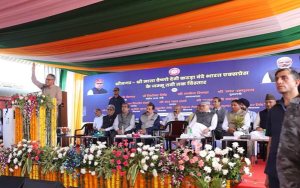
For decades, the idea of stepping onto a train in Jammu and arriving directly in Srinagar belonged to the realm of ambition rather than reality. That ambition became history today. Union Minister for Railways Shri Ashwini Vaishnaw flagged off the extended Srinagar–Shri Mata Vaishno Devi Katra Vande Bharat Express service up to Jammu Tawi Railway Station, directly linking Jammu and Kashmir by passenger train for the very first time. A single seamless rail corridor now connects two of the region’s most iconic destinations, promising not just faster journeys but a transformation in how people, commerce, and tourism flow across this breathtaking landscape.
Jammu Tawi Emerges as Key Rail Gateway
Jammu Tawi stands as one of the most important railway stations in northern India, serving as a crucial gateway that connects the Union Territory with the rest of the country. With extensive rail links to major destinations such as Kanyakumari, Howrah, Mumbai and other metropolitan hubs, the station plays a vital role in ensuring seamless mobility across regions.
Highlighting the significance of the development, Shri Vaishnaw during his address at the flagging-off event said that a major milestone has been achieved with the expansion of rail connectivity in Jammu and Kashmir.
With the train now reaching Jammu Tawi, travel to key pilgrimage destinations such as Shri Mata Vaishno Devi and Shri Amarnath will become more convenient and accessible for passengers across the country.
High Demand and Enhanced Travel Experience
The Railway Minister highlighted that the Vande Bharat service has witnessed full occupancy since its launch, reflecting its growing popularity among passengers, underlining its importance as a lifeline for Jammu and Kashmir as well as for the rest of the country. He added that today, the 20-coach Vande Bharat Express service between Jammu and Srinagar has been launched, marking a significant enhancement in passenger capacity on this vital route.
The Union Railway Minister Shri Ashwini Vaishnaw stated that this development comes less than a year after the Hon’ble Prime Minister Shri Narendra Modi inaugurated the Jammu–Srinagar rail link on 6th June last year, which laid the foundation for seamless rail connectivity in the region. The introduction of the expanded Vande Bharat service further strengthens this historic corridor, improving travel comfort, meeting rising passenger demand, and reinforcing all-weather connectivity between Jammu and Srinagar. He emphasized that the train has been designed specifically for operations in the region’s challenging climatic conditions, including sub-zero temperatures, with specialized systems ensuring uninterrupted functionality of onboard equipment.
Shri Vaishnaw further highlighted that the train incorporates advanced electronics and high-end semiconductor-based systems, making it a highly modern and technologically sophisticated mode of transport. He also pointed out that efforts have been made to integrate regional culture into the passenger experience by introducing Dogri cuisine onboard. Shri Vaishnaw said that passengers travelling on this route will get exposure to the culture of Jammu & Kashmir, including its landscapes, language, music and culinary traditions, making the journey more immersive.
Jammu and Kashmir: Paradise on Earth
Jammu and Kashmir, often described as the “Paradise on Earth,” is renowned for its breathtaking natural beauty, snow-capped mountains, lush valleys and serene lakes. The region is home to warm and resilient communities whose rich cultural heritage adds to its unique identity. Improved rail connectivity is expected to further boost tourism, enabling more people from across the country to experience the region’s scenic charm and cultural vibrancy.
The Union Minister observed that enhanced rail infrastructure is also facilitating economic growth by enabling smoother transportation of local produce. Jammu and Kashmir is known for its premium dry fruits, exquisite Pashmina shawls, apples and traditional handwoven carpets (kaleen), which are in demand across India. With better rail connectivity, the movement of these goods to markets nationwide is becoming faster and more efficient, thereby supporting local livelihoods and expanding trade opportunities.
Boost to Trade and Cultural Linkages
Shri Vaishnaw stated that this is India’s first experience with railway operations at such high altitudes, and the learnings gained will guide future infrastructure developments. He added that the railway line has significantly improved cargo movement in the region, reducing transportation costs and ensuring smoother logistics for essential goods such as fertilizers and dairy products like milk. Agricultural produce, including cherries, is also being transported through parcel services, enhancing market access for local farmers.
He further noted that the rail network has simplified logistics and contributed to economic activity in the region. Looking ahead, the focus will be on strengthening maintenance systems and deploying advanced technologies for bridges and tunnels to ensure safety and reliability in the Himalayan terrain.
Rail Freight Integration & Economic Linkages in Kashmir Valley
The completion of the Udhampur-Srinagar-Baramulla Rail Link (USBRL) has seamlessly connected the Kashmir Valley with the rest of India’s rail network. It has not only benefited passengers but also boosted the region’s business and economic activity. The commissioning of engineering landmarks such as the Chenab Rail Bridge, the world’s highest railway bridge, and the Anji Khad Bridge has enabled uninterrupted, all-weather rail connectivity to the region. This transformative infrastructure has paved the way for regular freight movement, significantly reducing transit time, improving reliability, and integrating the Valley more closely with national supply chains.
The Railway Minister boarded the Jammu–Srinagar Vande Bharat Express from Jammu and travelled up to Katra. Speaking to mediapersons onboard the train, he highlighted that nearly 2 crore kilograms of apples have already been transported from Srinagar to the rest of the country through the railway network.
Shri Vaishnaw later conducted an inspection of the Anji Khad Bridge and the Chenab Rail Bridge.
Future Expansion and Infrastructure Development
Shri Vaishnaw stated that the redevelopment of Jammu Tawi station is progressing rapidly, with expansion of platforms, additional entry points and improved passenger amenities to handle increasing traffic. He added that broader infrastructure initiatives, including line doubling and capacity enhancement on key routes, will further strengthen connectivity between Jammu and Kashmir and the rest of the country.
Shri Vaishnaw said that doubling work on the Jalandhar–Jammu section has been completed, while the Delhi–Ambala section is being upgraded to four lines, which has recently been approved by the Cabinet. He further stated that work is underway for doubling of the railway line between Qazigund and Baramulla to enhance capacity. He informed that projects such as the Poonch–Rajouri rail link and the Uri–Baramulla extension are under planning and Detailed Project Report stages.
The Qazigund-Baramulla line doubling will increase freight and passenger capacity through the Kashmir Valley, easing congestion, cutting travel times, and enabling smoother movement of goods and tourists. The Poonch-Rajouri rail link will integrate two historically underserved districts into the national rail network for the first time, catalysing local industries and improving access to healthcare and education. The Uri–Baramulla extension will push rail access deeper toward the border, opening remote areas to tourism and trade while strengthening civilian resilience.
Together, these projects will reduce the region’s heavy dependence on road transport, which remains highly susceptible to seasonal disruptions from landslides, snowfall, and harsh winters, while stimulating investment, generating employment, and fostering a stronger sense of social and economic inclusion for communities across the region.
The extension of the Srinagar–Katra Vande Bharat Express to Jammu Tawi marks another step towards integrating the region more closely with the national rail network, boosting tourism, facilitating trade and enhancing overall connectivity. With a convenient interchange at Jammu, passengers from across the country can now seamlessly access the Kashmir Valley, as Jammu is well connected with all major centres of India in every direction. This development is paving the way for greater people-to-people connect and deeper economic integration of Kashmir with the rest of the country.

Advertisement:














Add Comment