



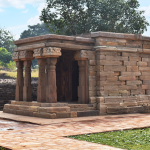

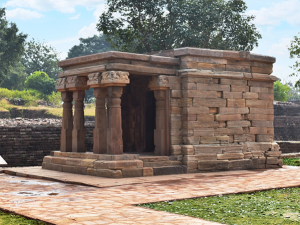
(Temple No. 17: A Masterclass in Early Gupta Proportions)
*From early structural temples to royal inscriptions, the state preserves one of the most significant concentrations of Gupta-era heritage in the world.
TTT NEWS NETWORK
BHOPAL | 19 MARCH 2026
Madhya Pradesh is emerging as a central landscape for understanding one of the most transformative periods in Indian history—the Gupta dynasty—often described by historians as the Golden Age of India. Across the state, a remarkable network of inscriptions, temples, and rock-cut monuments from this era offers rare insight into the political administration, religious life, and architectural innovation of early classical India.
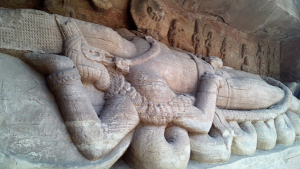
(Udaigiri Caves – known for intricate rock-cut sculptures and carvings)
India recently nominated the “Gupta Temples of North India” to UNESCO’s Tentative List on 11 February 2025 as a serial cultural property spanning several states including Madhya Pradesh, Uttar Pradesh, Rajasthan, and Bihar. The nomination recognizes the Gupta period as a formative phase in the development of Indian sacred architecture and artistic expression. Among these, Madhya Pradesh holds one of the most significant clusters of Gupta-era temples, inscriptions, and archaeological remains, making the state a central landscape for understanding the architectural and cultural achievements of the Gupta period.
The Gupta dynasty played a pioneering role in the evolution of structural temple architecture in the Indian subcontinent. Temples from this period introduced fundamental architectural elements that later became standard across Hindu temple design, including the garbhagriha (sanctum), mandapa (pillared hall), and mukhamandapa (entrance porch).
These early structures represent the transition from rock-cut shrines to freestanding stone and brick temples, showcasing refined engineering and aesthetic simplicity. The architectural vocabulary developed during the Gupta period laid the foundation for the Nagara style of North Indian temple architecture, while also influencing traditions that later evolved into Dravida architectural forms in southern India.
Among the regions associated with Gupta architecture, Madhya Pradesh hosts one of the largest concentrations of surviving monuments and inscriptions from this period, demonstrating the dynasty’s architectural experimentation and administrative reach.
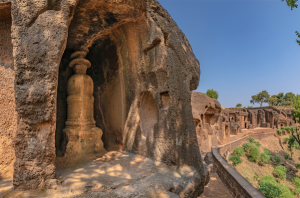
(A View of the Ancient Buddhist Caves in Mandsaur)
Prominent Gupta-era temples in Madhya Pradesh include:
• Temple No. 17 at Sanchi (Raisen district) – an early 5th-century temple featuring a square sanctum and pillared mandapa, considered one of the earliest surviving structural temples in India.
• Udayagiri Caves (Vidisha district) – rock-cut cave temples containing inscriptions referring to the reign of Chandragupta II, along with remarkable Vaishnavite sculptures.
Nachna Temple (Panna district) – an early stone temple dedicated to Parvati, built on a raised platform and dating to the 5th–6th centuries CE.
• Tigawa Temple (Katni district) – the Kankali Devi Temple, an example of early North Indian temple planning.
• Bhumara Temple (Satna district) – a Shiva temple notable for its sculptural detailing.
• Sakor Temple (Damoh district) and Deori Temple (Sagar district) – both reflecting the structural and stylistic features of Gupta temple construction.
• Pawaya (Gwalior district) – a terraced Vishnu temple site linked with the ancient city of Padmavati.
Together, these monuments illustrate early experimentation with load-bearing stone construction, flat roofs, and intricately carved doorways, architectural elements that later evolved into more elaborate temple forms across the Indian subcontinent.
Equally significant are the Gupta-era inscriptions discovered across Madhya Pradesh, which provide valuable historical records of governance, religious patronage, and social life during the dynasty.
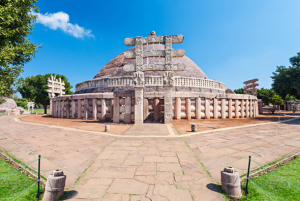
(Sanchi Stupa – a symbol of India’s ancient Buddhist heritage and architectural brilliance)
Key epigraphic sites include:
• Eran (Sagar district) – containing inscriptions linked to Samudragupta and Budhagupta, including a notable 510 CE inscription often cited in early discussions of the Sati tradition.
• Mandsaur (Mandsaur district) – home to an inscription of Kumaragupta I, documenting the migration of silk weavers and the construction of a Sun Temple in 437 CE.
• Udayagiri (Vidisha district) – inscriptions referencing the reign of Chandragupta II and royal patronage of religious monuments.
• Sanchi (Raisen district) – later inscriptions associated with the Gupta period appearing alongside the earlier Mauryan monuments.
• Shankarpur (Sidhi district) – where a copper-plate inscription from the reign of Budhagupta has been discovered.
• Indore Copper Plate Inscription – referring to guilds of oil merchants and reflecting the economic organization of the period.
• Durjanpur near Vidisha – where inscriptions referencing Ramagupta were discovered on Jain statues.
Together, these inscriptions help historians reconstruct aspects of Gupta administration, land grants, religious patronage, trade guilds, and social institutions, offering a detailed picture of governance and cultural life in central India during the early classical period.
Gupta inscriptions sites represent a continuous record of governance, ethics, and religious thought in the Indian subcontinent spanning several centuries.
The recognition of Gupta monuments on UNESCO’s Tentative List has brought renewed international attention to the historical significance of these sites. For scholars and travelers alike, the temples and inscriptions of Madhya Pradesh provide an extraordinary window into the artistic achievements, political systems, and spiritual traditions of early classical India.
As research, conservation, and responsible tourism initiatives continue, these monuments remain vital cultural landmarks—preserving the legacy of a dynasty that helped shape the architectural and intellectual foundations of Indian civilization.

Advertisement:


















Add Comment