






RAILWAY: TRUCKS-ON-TRAINS: A STRATEGIC MODAL SHIFT LED BY INDIAN RAILWAYS’ DEDICATED FREIGHT CORRIDOR
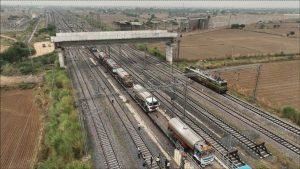
(By Combining Road Agility with Rail Efficiency, Trucks on Train Optimizes Long-Haul Freight through Multimodal Integration, Reducing Emissions, Congestion, and Logistics Costs0
TTT NEWS NETWORK
NEW DELHI | 22 JANUARY 2026
As India’s economy grows and consumption diversifies, freight movement has increased sharply, straining roads, fuel use, and air quality. To address this, Indian Railways, through its visionary Dedicated Freight Corridor (DFC) initiative, has introduced the innovative Trucks-on-Trains (ToT) service. Conceived as part of Indian Railways’ long-term freight transformation strategy, the DFC network provides the backbone that enables new-generation multimodal logistics.
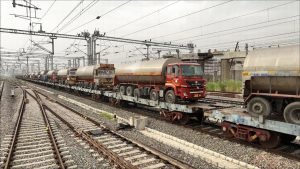
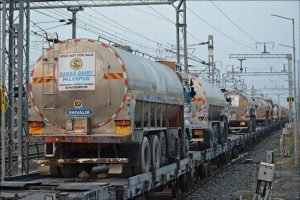
ToT integrates the flexibility of road transport with the efficiency and environmental benefits of electrified rail infrastructure developed under Indian Railways’ Dedicated Freight Corridor program. The service allows loaded trucks to be carried on specially modified flat wagons along the dedicated freight corridor. Trucks avoid long, congested highway journeys and travel by rail for the main haul. They then complete only short first- and last-mile road movements.
Economic Yet Reliable
At present, the ToT service operates between New Rewari and New Palanpur on the Western DFC network. It will be extended to additional sections as infrastructure development progresses. On the New Palanpur–New Rewari corridor, the service spans approximately 636 kilometres, cutting end-to-end transit time from nearly 30 hours by road to around 12 hours via the ToT service. This integrated road–rail solution enhances transit reliability, shortens turnaround times, and reduces overall logistics costs, while shielding long-haul freight movement from many of the uncertainties inherent in highway transport.
A key strength of the ToT lies in its simple and competitive pricing structure. Freight is charged on transparent weight slabs, ₹25,543 per wagon for trucks up to 25 tonnes, ₹29,191 for 25-45 tonnes, and ₹32,000 for 45-58 tonnes, while empty trucks are carried at only ₹21,894 per wagon. To further support the dairy sector, no GST is levied on milk tankers, making the service especially attractive for time-sensitive and perishable cargo. Enhancing operational flexibility, Open Indent booking has been available since January 2024, allowing customers to plan movements in line with their dynamic logistics requirements.
Operational data from the current financial year clearly reflects the growing traction of the service. During FY 2025 (April–December), the Trucks-on-Trains service handled a total of 545 rakes, moving more than 3 lakh tonnes of freight and generating revenue of ₹36.95 crore. This volume underscores ToT’s emergence as a commercially viable and scalable logistics product rather than a pilot-stage innovation.
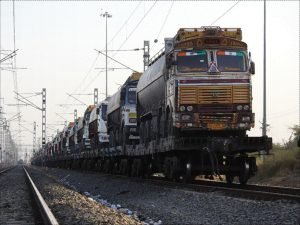
A closer look at origin-wise performance further highlights its strength. New Palanpur alone accounted for 273 rakes, handling about more than 2 lakh tonnes and generating revenue of ₹20.18 crore, demonstrating strong adoption from western India’s freight clusters, particularly in dairy and FMCG segments. New Rewari contributed almost equally in operational terms, with 272 rakes, moving around 0.1004 million tonnes and generating ₹16.76 crore in revenue. Together, these terminals illustrate how strategically located nodes on the DFC can anchor sustained multimodal freight flows and drive corridor-based logistics efficiency. The service has witnessed strong patronage from western India’s freight clusters, particularly from major customers such as the Gujarat Cooperative Milk Marketing Federation (Amul) for milk and dairy products, along with other logistics service providers. The relaunch of the Trucks-on-Trains service through a Memorandum of Understanding with GCMMF in June 2023 significantly reinforced industry confidence and helped anchor regular volumes from the dairy sector.
Pioneering Modal Shift
One of the most significant strategic outcomes of Western Dedicated Freight Corridor Trucks-on-Trains service is the modal shift of long-haul freight from road to rail. By transferring the longest and most energy-intensive segment of truck journeys to electrified, high-capacity dedicated freight corridors, the ToT model helps decongest highways, reduce dependence on imported fossil fuels, and optimise national logistics costs. Each freight train has the potential to replace dozens of long-haul trucks, resulting in smoother traffic flow, lower accident risks, reduced diesel consumption, and diminished wear and tear on road infrastructure.
An important economic advantage for transporters is the avoidance of highway toll costs. Long-distance trucking on national highways involves significant expenditure on toll plazas, which escalates logistics costs and increases trip uncertainty. By shifting the long-haul segment to rail, Trucks-on-Trains enables operators to bypass these recurring toll expenses entirely, improving cost predictability and margins, particularly for high-frequency and long-distance movements.
Cleaner & Safer Transport
The environmental gains are reinforced by the fact that the entire DFC network is fully electrified. Shifting trucks from road to rail significantly reduces emissions of carbon dioxide (CO₂), nitrogen oxides (NOₓ) and particulate matter. As India’s power generation mix progressively incorporates higher shares of renewable energy, the carbon footprint of rail-based freight under the ToT model is expected to decline further. Beyond tailpipe emissions, Trucks-on-Trains also addresses the often-overlooked issue of road dust pollution. Heavy truck traffic is a major contributor to dust generation on highways, adversely affecting public health, agriculture, and roadside ecosystems. By moving truck traffic to rail corridors, ToT helps improve air quality for communities living along major transport routes. The tangible impact of this shift is clearly visible on the Palanpur–Rewari corridor, spanning approximately 636 kilometres. When trucking over this stretch is shifted to rail, nearly 48875 trucks are effectively removed from highways for the core journey, operating only for first- and last-mile delivery. This transition results in estimated diesel savings of about 88,81,285 litres, while preventing the emission of approximately 2,30,91,343 kilograms of carbon dioxide (CO₂). These figures demonstrate how corridor-based modal shift delivers measurable environmental and energy benefits at scale.
Another critical advantage of the service is its resilience to adverse weather conditions. Road transport in many parts of India is highly vulnerable to fog, heavy rainfall, extreme heat, and poor visibility, particularly in northern regions during winter months, where dense fog frequently disrupts highway movement and increases accident risks. Rail operations on dedicated freight corridors, equipped with advanced signalling and controlled right-of-way, are far less susceptible to such disruptions. By shifting the longest journey segment to rail, ToT enhances schedule reliability and ensures continuity of supply chains even under challenging weather conditions.
Long-distance truck driving is physically demanding and accident-prone. By reducing continuous and long driving hours, the ToT model lowers driver fatigue, improves working conditions, and contributes to safer highways with fewer collisions and casualties. Reduced road traffic also translates into lower infrastructure damage and reduced public expenditure on road maintenance.
A New Revenue Stream for Rail-Based Logistics
From a commercial perspective, Trucks-on-Trains has emerged a new and sustainable revenue stream for rail-based logistics. Since inception, the service has completed over 1,955 trips, handled more than a million tonnes of freight, and generated cumulative revenue exceeding ₹131 crore. Strong uptake from sectors such as dairy, automobiles, Fast-Moving Consumer Goods and food processing reflects growing industry confidence in the model. The relaunch of the service through a Memorandum of Understanding with the Gujarat Cooperative Milk Marketing Federation (GCMMF) in June 2023 further reinforced its credibility among large institutional shippers.
Looking ahead, scalability is being strengthened through the development of new-generation wagon designs under the Flat Multipurpose (FMP) platform, engineered to carry trucks more efficiently, safely, and at higher payloads. These wagons will enhance loading efficiency and operational flexibility across varying truck configurations. Simultaneously, the introduction of additional Origin–Destination points and terminals across the DFC network will reduce first- and last-mile costs and expand the service’s reach to new industrial clusters.
From a forward-looking perspective, the service opens new possibilities for Indian businesses seeking reliable, pan-India market access with predictable transit times. For perishable agricultural producers and food-processing industries, ToT enables true first-mile to last-mile integration. Fresh chikoo grown in Maharashtra can be transported from orchards to nearby ToT terminals, moved rapidly over the Dedicated Freight Corridor, and delivered by road to distant consumption centres with minimal handling and time loss. Similarly, onions from Nashik, one of India’s most important horticultural hubs can reach northern and eastern markets efficiently, reducing spoilage and price volatility.
Part of a Larger Multimodal Vision
Trucks-on-Trains is not a standalone initiative but a core component of Dedicated Freight Corridor Corporation of India Limited’s (DFCCIL) broader multimodal logistics vision. Alongside high-capacity freight corridors, multimodal cargo terminals and logistics parks, the service ensures that road and rail complement each other, deploying each mode where it is most efficient, economical, and environmentally sustainable.
In essence, Trucks-on-Trains represents a structural shift in India’s freight transport paradigm. By combining innovation, electrified infrastructure, competitive pricing, operational resilience, and clear environmental and social benefits, DFCCIL is demonstrating that freight movement can be efficient, reliable, and responsible at the same time.

Advertisement:















Add Comment