







BY PRASHANT KUMAR MISHRA
( EX GM, MODERN COACH FACTORY, RAEBARELI & RAIL COACH FACTORY, KAPURTHALA)
NOIDA | 16 APRIL 2026
After my earlier and deeply instructive engagement with the parks of Mumbai , where I had, with some effort and considerable personal restraint, mapped the behavioural patterns of urban humanity compressed within limited geographical space, I found myself presented with an opportunity to survey a Noida park, a development that I accepted with the seriousness appropriate to a scholar expanding the scope of his research.
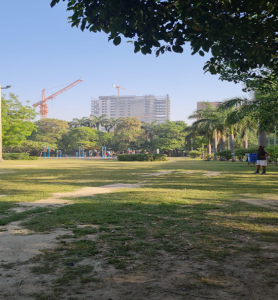
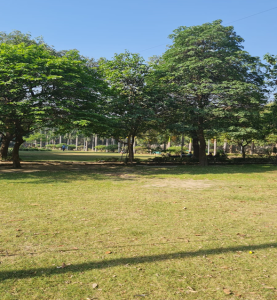
The Noida Park, I soon realised, differed not merely in size, but in temperament, being a large and open expanse surrounded by orderly rows of housing societies and commercial establishments, as though civilisation itself had assembled in a quiet semicircle to observe how its inhabitants might conduct themselves when briefly released into nature and mild anonymity.
Assuming, without formal appointment, the role of principal observer, I began my rounds.
The earliest to arrive, and therefore the first to establish informal sovereignty, are the Snabbit Snappers, who secure benches with quiet efficiency and immerse themselves in flickering abyss of short-form digital distractions with such intensity that one suspects national policy, personal destiny, and grocery logistics are being resolved simultaneously beneath their thumbs.
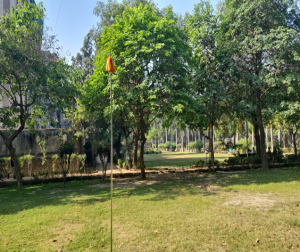
They remain thus engaged until, at some critical moment, a message appears which recalls them sharply to the demands of their professional existence. At this signal, they rise with admirable urgency and depart in haste, presumably toward dark stores, bright dashboards, and awaiting households who are not inclined toward philosophical delay.
In one corner unfolds a scene of such domestic precision that it deserves formal recognition.
Here, the Lady of Pranayam Command supervises her husband’s breathing with the vigilance of a regulatory authority, ensuring that each inhalation meets acceptable standards legislated by Baba Ramdev and each exhalation does not drift into indiscipline, while the gentleman, whose sincerity is beyond doubt, complies with visible concentration and occasional distress.
Any lapse invites immediate correction, delivered with piercing clarity, and the surrounding audience divides neatly into two camps, because while several ladies observe with approval, noting the successful extension of governance beyond the home, a number of men watch with quiet sympathy, united by a shared understanding that certain systems operate under continuous supervision. Meanwhile the husband starts next round of pranayama with the resignation of someone who has long accepted that freedom, like oxygen, comes in measured quantities.
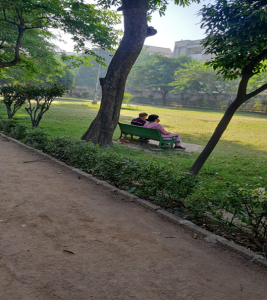
Circling the park with relentless continuity are the Marathon Practitioners. The men on perpetual motion. They appear to have entered into a long-term agreement with endurance itself, completing lap after lap without visible fatigue. Those still struggling to complete even a single round observe them with a mixture of admiration and mild existential unease. It seems these practitioners have mistaken repetition for purpose—driven by a belief that stopping might require an explanation they aren’t prepared to give.
In a corner devoted to structured exertion, we encounter the Coach and Her Protégée, engaged in a sequence of stretches that combine aspiration with history.
The coach, a figure of unquestioned authority, bears the unmistakable imprint of having done distinguished justice to Delhi’s culinary heritage; its effects have redistributed themselves across her frame with commendable enthusiasm. Yet, her reflexes remain sharp and her instructions precise.
The protégé bends and stretches in pursuit of a different destiny, though the outcome remains, for now, a matter of patient observation. Someone might conclude that the coach’s presence offers a gentle reminder that such ambitions must contend with lived experience.
The Open Gym Assembly presents a study in interpretive exercise, where each piece of equipment is approached not merely as a tool, but as an opportunity for personal expression.
Some row with determination, others press with conviction, and a few rotate heavy iron wheels with such passion that a casual observer might fear the Earth’s rotation depended entirely upon their efforts.
Amidst this vigorous activity, however, there sits one gentleman, entirely still and at peace, observing the proceedings with calm detachment, as though contemplating whether the entire enterprise is necessary, or merely entertaining.
At an hour when most citizens are still deep asleep, the Yoga group completes its disciplined routine, folding mats with geometric precision before concluding with a resonant “Jai Shri Ram,” after which the trainer pauses to listen carefully to each response, assessing not merely participation but conviction and enthusiasm.
Any silence is quietly recorded for future consideration, leaving the participants to reflect upon the alignment between their breath and their belief.
At a precisely calibrated moment, when the park has settled into what one might optimistically call a civil rhythm, the Laughter Club announces itself with a sound so sudden and so commanding that it pierces the morning air with remarkable authority.
One particular note rises above the rest, a deep and resonant outburst that bears an uncanny resemblance to what one imagines might have echoed through prehistoric forests when early Neanderthal man first discovered either humour or alarm, the distinction even now remaining somewhat unclear. It raises interesting possibilities for serious researchers to examine that evolution has preserved certain sounds without fully retaining their original context.
This is followed by a series of softer, faintly melancholic undertones, reminding the audience of the eternality of sadness.
Amidst this orchestrated exuberance stands one gentleman, standing erect and still, who refuses to participate, maintaining a quiet dignity that suggests a firm belief that laughter, if it is to occur, must arise naturally, and that contrived joy, however well-intentioned, is a compromise too far.
Not far away, seated with remarkable seriousness, is the Newspaper Sentinel, a gentleman immersed in multiple newspapers, turning pages with deliberation while others monitor their heart rates and step counts.
One cannot help but admire his sense of national duty, for while the rest of the park attends to individual well-being, he has clearly assumed responsibility for monitoring the pulse of the nation, ensuring that developments of importance are neither missed nor misunderstood. If the nation falters, it will not be for lack of his awareness.
Among the most persistent figures are the Lone Lady Walkers, who begin their rounds early and continue with unwavering focus, often murmuring to themselves in a manner that suggests either strategic planning or deeply held opinions regarding domestic arrangements.
Whether this represents a commitment to fitness or a carefully negotiated retreat from the structured discipline of daughters-in-law remains uncertain, though the intensity of their routine suggests that both interpretations may hold merit.
At intervals, the calm is disrupted by Octogenarian Runners, who pass by with surprising speed and admirable stamina, leaving younger observers awestruck to reassess both their fitness levels and their long-term expectations.
Then there is the Walker with the Cane, likely an ex-law enforcement officer who doesn’t walk so much as patrol. His cane and head are tilted at a precise 20-degree angle, eyes fixed on the horizon. He has long ago delegated his immediate surroundings to subordinates; he has bigger pictures to see. He carries his cane less for support than as a relic of office—had he been military, he’d likely saunter along with a howitzer slung as casually as an umbrella.
The park authorities have installed three notices requesting that visitors refrain from damaging plants, maintain decency, and avoid littering, and it is a tribute to the consistency of human behaviour that these are violated in precisely that sequence, suggesting that even indiscipline follows a certain internal order in Noida.
In one animated corner, the Cleaning Ladies’ Assembly , of various house help online services, conducts discussions of remarkable energy, where experiences are exchanged and observations are delivered with candour.
Here information flows freely-domestic accounts, employer behaviour, economic realities are shared with clarity and theatrical precision. If the park is the stage, this is where the script is rewritten and running commentary about different household is broadcast.
The park itself remains somewhat unkempt, reflecting a delicate balance between usage and neglect. Visitors deposit litter with casual ease, and the cleaning staff, perhaps guided by a philosophy of reciprocity, respond with equal indifference, resulting in a form of poetic justice rarely achieved through formal governance.
Evidence of intense nocturnal activity is also present, in the form of bottles, cans and packets of various hues, suggesting that the park, by night, hosts a different society altogether, one that distributes both love and litter with equal fervour.
And then, of course, there is the observer.
Walking with measured pace, observing with academic seriousness, and contributing partially to his own fitness goals, he remains convinced that his pathbreaking research and documentation of human civilisation under controlled greenery is essential to further the frontiers of human knowledge. He is, in his own mind, the chronicler of the suburban soul.
Postscript: Mumbai vs Noida
Having now studied both Mumbai and Noida parks with equal diligence, one is compelled to record a few distinctions.
The Mumbai park is compact, energetic, and democratic, where every square foot is contested and every individual operates under the pressure of proximity, producing a society that is efficient, expressive, and slightly breathless.
The Noida park, by contrast, is expansive, reflective, and faintly theatrical, where space allows behaviour to unfold with greater elaboration, and individuals appear less concerned with reaching somewhere than with being seen while proceeding.
In Mumbai, people walk as though time might outrun them.
In Noida, they walk as though time has already agreed to wait.

Advertisement:

















Add Comment