






TTT NEWS NETWORK
NEW DELHI | 14 DECEMBER 2025
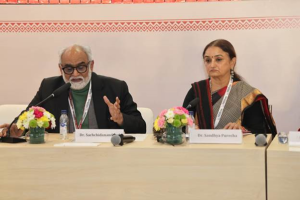
Indira Gandhi National Centre for the Arts (IGNCA) organised the academic programme titled ‘Natyashastra – Synthesis of Theory and Praxis’ during the 20th Session of UNESCO’s Intergovernmental Committee for the Safeguarding of Intangible Cultural Heritage at the iconic Red Fort, Delhi. Chaired by Padma Vibhushan awardee, Scholar, Guru and former Member of Rajya Sabha Dr. Sonal Mansingh. The programme brought together eminent scholars and institutional heads – Dr. Sachchidanand Joshi, Member Secretary, IGNCA; Dr. Sandhya Purecha, Chairperson, Sangeet Natak Akademi; Shri Chittaranjan Tripathy, Director, National School of Drama; Prof. (Dr.) Sudhir Kumar Lall,HoD, Kalakosa, IGNCA and Dr. Yogesh Sharma, Associate Professor, Kalakosa IGNCA; to deliberate on the ‘Natyashastra’ as a living knowledge system that continues to integrate theory and practice within India’s performing arts traditions. A short film on the inscription of Natyashastra in the UNESCO’S Memory of the World Register prepared by the IGNCA Media Centre was shown at the venue which was well received.
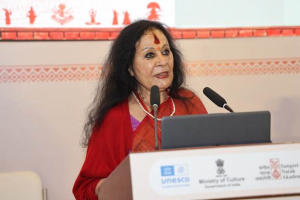
The Chair address on the relevance of the Natyashastra was delivered by Padma Vibhushan Dr. Sonal Mansingh, who articulated the enduring universality of the text, highlighting its sustained relevance across time and cultures, and its continued capacity to inform contemporary artistic practice, aesthetic reflection, and cultural discourse.
Dr. Sachchidanand Joshi reflected on the Natyashastra as an intellectual continuum rather than a closed canon, emphasising its dialogic nature that invites continual reinterpretation and renewal, while also situating it as a living knowledge system integrating theory and practice, whose conceptual rigour and performative logic offer a dynamic framework for understanding artistic creation, transmission, and interpretation across changing historical and cultural contexts.
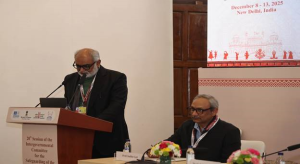
Dr. Sandhya Purecha presented a comprehensive overview of the Natyashastra, drawing attention to its systematic structure, layered philosophical depth, and wide-ranging pan-Indian influence, while illustrating how the text has informed diverse artistic traditions and performance practices across regions and generations. Shri Chittaranjan Tripathy spoke on ‘Contemporary Theatre and the Natyashastra’, elucidating how classical dramaturgical principles embedded in the text continue to shape modern theatrical expressions, influence modes of performance, and inform pedagogical practices within contemporary theatre training and production.
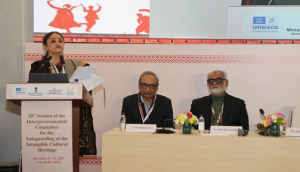
Prof. Sudhir Lall, in his introductory remarks, noted that the Natyashastra offers a comprehensive vision of the arts, codifying the principles of drama, dance, and music while situating them within a larger metaphysical framework that reflects human experience and gestures towards transcendence. He observed that its enduring vitality lies in the union of thought and action, where abstract ideas find expression through gesture and voice, and in its seamless integration of theory and praxis, through which stagecraft and performance continue to be renewed across India’s diverse and living artistic traditions.
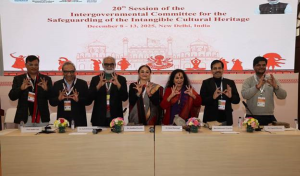
Dr. Yogesh Sharma, provided an insightful exposition on ‘Natyangas: the Conceptual Framework of the Text’, elucidating the constituent elements that underpin performance aesthetics and guide meaning-making in Indian arts. He highlighted how the intricate interplay of these components informs the nuanced expression, emotive depth, and structural coherence of drama, dance, and music, demonstrating the Natyashastra’s enduring relevance as both a theoretical guide and a practical framework for artistic creation.
The programme concluded with closing remarks from the speakers, who offered succinct reflections on the discussions and emphasised the enduring importance of sustained engagement with classical knowledge systems. The event reaffirmed the Natyashastra as a seminal intellectual and artistic resource, bridging tradition and modernity, and highlighted IGNCA’s steadfast commitment to fostering informed and rigorous discourse on India’s cultural legacy. The session was attended by cultural enthusiasts, scholars, and practitioners, drawing together a diverse gathering deeply engaged in exploring the continuing relevance of India’s classical performing arts.

Advertisement:










Add Comment