







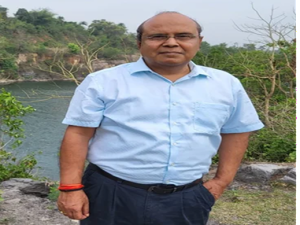
By PRASHANT KUMAR MISHRA,
( EX. GENERAL MANAGER, MODERN COACH FACTORY, RAEBARELI & RAIL COACH FACTORY, KAPURTHALA)
MUMBAI | 23 MAY 2026
After more than four decades of service life, I finally got the opportunity to stay in my village without the constant anxiety of rushing back to office, without endlessly checking phones and messages, and without carrying that peculiar institutional illusion that the world cannot function unless one personally monitors everything round the clock.
Railway service slowly conditions officers into believing they are indispensable to civilisation itself. Leave, therefore, becomes less an entitlement and more an act of courage.
The moment an officer gathers sufficient courage to apply for leave, the institutional machinery swings into action. The boss looks at him with a mixture of disappointment and moral superiority and begins narrating stories about officers who “do not understand the gravity of the present situation.” He himself, naturally, has not slept for five nights in the last week. The control phone, he informs you solemnly, kept ringing the whole night. Controllers also know whom to call because “Saheb himself monitors everything and gives decisions immediately.”
If moral pressure does not work, emotional blackmail follows: “Just postpone your leave by ten days. Let the present crisis pass.”
In Indian Railways, crises possess extraordinary longevity. They survive transfers, retirements, all Five-Year Plans and twenty years road maps. An officer’s career is spent passing from one crisis to another with unerring regularity. Designations change, postings change, governments change, but crises remain remarkably loyal to the institution.
In such an environment, only daredevils apply for leave without guilt.
This time, however, I finally stayed back in my village without worrying about pending files, control phones or production targets. For the first time in many years, I had the luxury of remaining still, knowing that the days of seeking permission for leave were finally over. What a profound feeling it was.
Perhaps one understands a village only when one stops arriving there as a visitor and begins quietly observing it as time itself moves around you.
When we were children, teachers would often ask us to write an essay on “My Village.” We wrote with extraordinary confidence about ponds, mango orchards, brotherhood, simplicity and fresh air, as though every village in India was a miniature paradise temporarily inconvenienced by the absence of electricity. Our village was always the best. Our school was always the best.
Those essays now appear less like descriptions and more like collective civilisational nostalgia.
This time, when I returned after a long gap, I realised that the village of those essays no longer exists. Perhaps it had already begun disappearing long ago.
What struck me first was the sheer physical transformation.
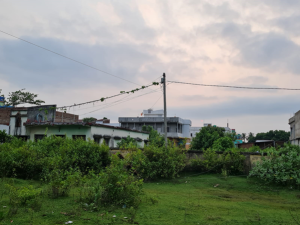
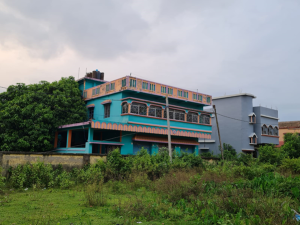
I could hardly recognise many parts of my own village. Paddy fields had disappeared. Mango orchards had vanished. In their place stood rows and rows of newly constructed houses and two-three storied buildings. The entire landscape now seemed wrapped in concrete of every conceivable shade.
Pink houses. Green houses. Blue houses. Grey houses. Each colour appeared less a matter of aesthetics and more a declaration of arrival, prosperity and personal identity.
Mud houses have almost vanished. I could count barely three or four surviving homes with mud walls and clay tiles. Looking at them felt like looking at the last surviving pages of an old manuscript nobody reads anymore.
And yet, one cannot deny the material improvement.
The old visible poverty of rural India has reduced enormously. In childhood, one routinely encountered hunger, deprivation and quiet suffering. Today nobody looks emaciated. Labour for household work is difficult to find.
Government ration schemes and direct cash transfers have ensured that basic survival is no longer the daily anxiety it once was.
A certain dignity — and unmistakable affluence — has arrived in rural life. But prosperity never travels alone. It brings with it an entirely new philosophy of living.
Smartphones are everywhere. Reels flow endlessly. People sit silently watching them, suddenly chuckling to themselves, occasionally bursting into loud laughter, and then forwarding them with missionary zeal to others similarly trapped in the same digital universe.
Amazon and Flipkart deliveries now arrive in villages where even inland letters once struggled to reach on time.
Air conditioners, which nobody had seen or even heard of in my childhood, now hum inside homes that once survived perfectly well through shaded verandahs, mud walls and airflow techniques perfected quietly over generations without any architect using imported English terminology.
Roads and connectivity are astonishing. Distances have psychologically collapsed. Villages no longer feel remote from the world. Roads branch endlessly in every direction, offering multiple routes to every destination. Life itself no longer appears about taking the first step, but about deciding which road to take.
And yet, somewhere amidst this transformation, time itself appears to have changed character. One rarely sees chessboards and carroms now, once such an integral part of village life.
Entire evenings used to disappear around a carrom board placed under a lantern, accompanied by laughter, fierce arguments and unsolicited advice from spectators who never actually played.
Chess games could continue for hours with extraordinary seriousness. A single move would be debated as though national security depended upon it.
Today, in the world of internet reels and endless scrolling, who has the patience for such leisurely pleasures?
The modern world has not merely accelerated movement. It has accelerated thought itself.
The village earlier possessed time — unstructured, slow-moving, conversational time. People sat together without purpose. Silence was not considered awkward. Even boredom had dignity. They did not wait for time; time waited for them.
Today one may find ten people sitting together physically, yet each is mentally elsewhere — absorbed in separate digital worlds flowing silently through mobile screens.
I sometimes feel the smartphone has altered Indian civilisation more profoundly than even television or electricity.
Earlier, village aspirations were local. A man compared himself with neighbouring villages. Today the young villager no longer compares his life with the next village or nearby town. His reference points are now Delhi, Mumbai, Dubai and the glittering digital lives endlessly streaming through Instagram and reels. The smartphone has quietly dissolved geographical boundaries; ambition now travels faster than roads. Desire itself has become globalised.
The village no longer seeks merely comfort. It seeks participation in the same dream being sold to the rest of humanity.
And perhaps that is inevitable.
After all, urban India spent centuries romanticising villages while ensuring that anyone with opportunity wished to escape them. Nobody wants to remain permanently picturesque for somebody else’s nostalgia.
Yet while observing all this, another thought disturbed me deeply. The village has gained comfort, but lost memory.
The river itself has nearly disappeared because of large-scale sand excavation. Wells have vanished as groundwater levels have fallen sharply. People now buy water jars for drinking — something unimaginable in my childhood.
Ponds have been filled up. Traditional water conservation systems, refined through generations of practical wisdom, have been forgotten with astonishing speed and utter indifference.
Civilisations often decline not when they become poor, but when they become disconnected from the ecological intelligence that sustained them quietly for centuries.
What saddened me most was not environmental degradation alone, but the disappearance of continuity.
The older village lived with the accumulated memory of generations. Houses evolved slowly. Trees were planted not merely for oneself, but for descendants.
Water bodies were constructed and maintained because survival depended upon them. Life moved within limits imposed by geography, season and collective memory.
Modernity has broken that continuity.
The new village increasingly behaves like a small city — consuming more, remembering less, leaving behind plastic, concrete and growing mountains of waste.
Even government buildings reflect this mentality. Earlier offices were utilitarian, austere and durable. Today many structures are large, polished and ambitious, yet some stand abandoned within a few years. We build more impressively than before, but perhaps think less long-term.
And still, despite everything, something deeply Indian survives.
Tea shops remain crowded. Political debates continue with undiminished energy. Human adaptability remains astonishing. Villages absorb every technological shock without completely surrendering their social instincts.
India’s villages are neither dying nor surviving in the old sense. They are becoming something entirely new — strange hybrid spaces where buffaloes stand outside houses fitted with air conditioners, where gym-going youth discuss protein supplements beside paddy procurement prices, where ancient caste identities coexist uneasily with digital aspirations and online consumerism.
Standing quietly in my village after forty years, I realised something else too. The transformation was not merely external. The village had changed. But so had I.
The child who once wrote sentimental essays on “My Village” did not yet
understand complexity. Age slowly removes illusion, but in return it offers perspective.
And perhaps that is why returning to one’s village after decades feels so unsettling.
One goes there searching for memory, but ends up discovering oneself.

Advertisement:
















Add Comment