



(Threads of History: How a Royal Fugitive’s ‘Kete Dhoti’ Empire Shaped Chanduli’s 285-Year-Old Durga Puja)
BY DEBAJYOTI CHAKRABORTY
KOLKATA | 17 OCTOBER 2026
The historic Mitra family Durga Puja in Chanduli, East Burdwan, is celebrating 285 years of a legacy that fundamentally transformed Bengal’s textile history. The ancestral celebration, affectionately known to locals as “Babuder Barir Puja,” continues to be preserved by family descendants, including Satya Sundar Mitra, Utpal Mitra, and Debdutta Mitra.
To reach the scenic village of Chanduli in the Katwa-II subdivision, travelers can head roughly 136 km north of Kolkata for a perfect rural weekend escape.
The roots of this centuries-old tradition trace back to Hatuballab Mitra, the Chief Deputy of the princely state of Tripura. Around 1740, Hatuballab fled intense political upheaval in Tripura, carrying significant wealth with him to Bardhaman. Settling in Chanduli village near Katwa, his financial acumen allowed him to establish a vast zamindari estate. He quickly recognized the potential of the local weaving community and launched a major textile enterprise. This venture birthed the iconic “Kete Dhoti” (Khete Dhoti)—a highly durable, eight-cubit thick cotton garment that became a hallmark of the region’s golden age of weaving.
Today, this family festival is far more than a religious gathering. It stands as a vital cultural bridge, linking the royal ancestry of Tripura, the peak of Bengal’s textile heritage, and enduring zamindari customs. According to Debdutta Mitra, whose late father Mriganka Sekhar Mitra served as a custodian of the puja for over thirty years, the annual event remains a living testament to a migration that reshaped the region’s cultural and economic landscape.
Dubbed the “Kete Dhoti” (or “Khete Dhoti”) due to its production near Katwa, the distinctive attire has fast become a household staple across Bengal.
Operating under the reign of Nawab Alivardi Khan and the shadow of ongoing Bargi (Maratha) invasions, Hatuballab’s overnight commercial success has earned his lineage the permanent historical moniker of “Kapure Mittir” (The Cloth Mitras).
When Hatuballab Mitra sought asylum in the bustling village of Chanduli during the reign of Nawab Alivardi Khan, he brought with him immense wealth, administrative brilliance, and royal customs from the courts of Tripura. The Durga Puja he instituted at the family’s administrative kachari (court) became a reflection of this mixed heritage.
For nearly three centuries, the Mitra family’s Thakur Dalan (festival courtyard) has stood resilient against the passage of time—surviving the terror of historical Maratha (Bargi) invasions, the transition of empires, and the decline of the zamindari system.
Looms and Liberation: The Dual Legacy of Bengal’s Historic Pujas
The historic Chanduli Mitra Bari Puja owes its unique legacy to Bengal’s traditional weaving industry, according to family elder Swapan Kumar Mitra. Speaking to The Travel and Tourism Times, Mitra highlighted the legacy of the Kete Dhoti, explaining how family patriarch Hatuballab channelled his wealth into organizing local weavers to produce the famous eight-cubit (aat-haat) thick cotton Kete Dhoti. This booming loom industry directly funded the family’s grand autumn festivities. More than a religious event, the Puja served as an economic anchor. Through the weaver’s tribute, local artisans, farmers, and weavers would gather at the kachari (estate office) during Durga Puja to dedicate their finest textiles to the deity and receive the zamindar’s blessings.
Meanwhile, historical records detail a stunning military turnaround where Nawab Alivardi Khan routed Maratha forces during their own festive celebrations. Occupying Katwa under the strategic advice of Mir Habib, the Marathas had seized Hooghly and its vital port. Riding high on their conquests under General Shesharao, Maratha commander Bhaskar Pandit ordered a lavish, large-scale Durga Puja in September, funded entirely by plundered wealth.
However, the revelry ended in disaster at midnight on 27 September (the morning of Mahanavami). Capitalizing on the festive distraction, Alivardi Khan’s royal army launched a swift, decisive midnight assault on the Maratha camp at Dainhat, located along the Brahmani River near Katwa. The surprise offensive caught the occupying forces completely off guard, leaving them no time to retaliate and forcing a chaotic, hasty retreat that liberated the entire region.
Centuries-Old Mitra Bari Durga Puja Fuses Royal Tripura Legacy with Bengal’s Handloom History
CHANDULI — At the ancestral estate of the Mitra (Mittir) family in Chanduli’s Kapura, a centuries-old Durga Puja tradition continues to thrive, seamlessly surviving the tests of time and family partition. Amidst the modern, theme-based pandals that dominate contemporary Bengal, Chanduli’s Mitra Bari Durga Puja stands out as a profound reminder of how displacement, resilience, and business acumen can give birth to an enduring legacy of faith and fabric.
The historical roots of this unique celebration trace back to a successful military rout, after which Nawab Alivardi Khan inspected an abandoned enemy camp. Amidst the discarded items, royal troops recovered a rare, two-armed idol of Durga Bhavani, which had been left behind by fleeing forces and its sculptor. In a strategic gesture of goodwill, Nawab Alivardi Khan handed the liberated deity over to Hatuballab Mitra, a prominent local landowner and renowned cloth merchant from the Dainhat area.
Today, the descendants of Hatuballab Mitra ensure that this rich heritage remains unblemished. The idol is still meticulously sculpted following ancient iconographic scripts, while the annual rituals reflect a unique blend of royal Tripura stateliness and traditional, rural Bengali zamindari warmth. More than just a religious festival, the event serves as an annual family reunion where the history of a refugee bureaucrat who “revolutionized Bengal’s looms” is chanted alongside sacred Vedic hymns.
Historical records show that while the original family lineage eventually fractured, its deep-rooted religious rituals endured. Over time, the grand celebration split into two distinct festivals divided between the competing branches of the family.
Today, the elder branch’s festival is locally celebrated and recognized as “Babu-der Puja” (Puja of the Babus). Meanwhile, the younger branch carries on the tradition under the banner of the “Mittir Bari-r Puja” (Puja of the Mitra House). This historic schism and the resilience of the rituals remain well-documented in local folklore, Wikipedia records, and regional literature. Notable references include the classical verses of Baneshwar Vidyalankar, the court poet of the Burdwan Royal Estate, alongside Sanat Kumar Hazra’s prominent historical chronicle, “Bargi Elo Deshe” (The Maratha Invasions).
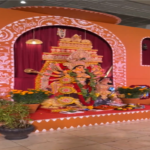
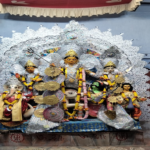
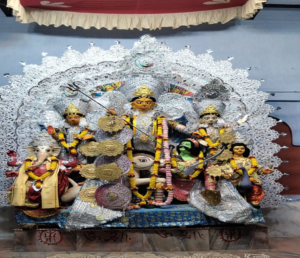
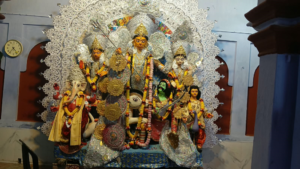
In recent developments, Mr. Mitra has revived the Durga Puja rituals within his ancestral home, introducing striking structural adaptations to the recovered idol. Drawing inspiration from the traditional style of the Tripura royal deities, the redesigned idol now features a uniquely colour-coded ensemble: a red Ganesha, a yellow Kartik and Lakshmi, a white Saraswati, a horse-mounted lion, and a green Mahishasur.
Marking a remarkable gesture of historical gratitude, the deity Kartik features an Islamic Nagara (drum) sculpted at his feet in honor of Nawab Alivardi Khan. Even with these elaborate iconographical changes, the primary two-armed structure of the Durga idol remains completely unaltered.

Advertisement:

















Add Comment