





TTT NEWS NETWORK
THIRUVANANTHAPURAM | 25 AUGUST 2026
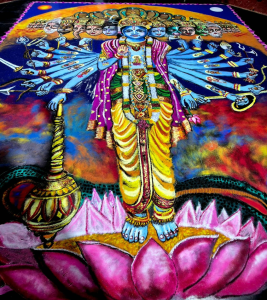
A large spectacular rangoli depicting Lord Krishna revealing his Vishwaroopam to Arjuna is drawing attention at Kanakakkunnu as art of the Onam tourism celebrations organised by the Department of Tourism. The striking artwork has been created by Niruba Sathish, librarian at KITTS, (Kerala Institute of Tourism and Travel Studies), who has been practising the traditional art of rangoli for nearly three decades.
Shri P.C. Vishnunadh, Minister for Tourism, Cinema and Culture, said this year’s Onam celebrations have been designed with a strong focus on Kerala’s traditional art forms. A wide range of programmes has been arranged to attract visitors to Kanakakkunnu, the key venue for the week-long Onam celebrations organised by the Tourism Department. This large rangoli artwork depicting Lord Krishna’s Vishwaroopam is one among the attractions. Niruba took four days to complete the portrait. Working entirely with her fingers, she carefully blended multiple colours to create the facial features and other intricate details of the image. Using colour powders, rice powder and other natural materials, the rangoli portrays the divine Vishwaroopam, the cosmic form of Lord Krishna revealed to Arjuna in the Bhagavad Gita.
The artwork seeks to capture the idea of oneness and the profound spiritual message conveyed by Lord Krishna to Arjuna. Her Vishwaroopam at Kanakakkunnu brings together devotion, tradition and visual artistry, adding a distinctive cultural attraction to this year’s Onam tourism celebrations. For Niruba, the artwork is also a continuation of a family tradition.
“My mother used to create pictures during Pongal. I developed that tradition further through my own work,” she says. She has been creating rangoli artworks, predominantly depicting gods and deities, for around 30 years. What began as an art form inspired by her mother has evolved into a distinctive creative practice that combines traditional rangoli techniques with detailed portraiture.
In Tamil Nadu, where the tradition of drawing kolam (a traditional geometric floor art) at the entrance of homes is deeply rooted in everyday life and festivals, Niruba was introduced to the art through her mother. Her mother regularly created kolams and also drew pictures during Pongal. Inspired by her mother’s creativity, Niruba began experimenting with the art form and gradually developed her own style, focusing particularly on gods and deities. Over the years, what began as an influence from her mother evolved into a three-decade-long passion for creating elaborate rangoli artworks.

Advertisement:











Add Comment