








BY P. K. MISHRA
NOIDA | 19 SEPTEMBER 2026
The dedication of the completed Western Dedicated Freight Corridor to the nation by the Prime Minister Narendra Modi on 8 September marks an important milestone in the transformation of Indian Railways. The Government has given a major thrust to railway infrastructure through electrification, new lines, doubling and multiple-lining, station redevelopment, modern trains, improved safety and signalling systems, and creation of additional capacity on some of the country’s busiest corridors.
Speaking at Vadodara, the Prime Minister summed up the larger purpose of infrastructure creation in words that go well beyond any single project: “We are strengthening India’s infrastructure to move people and goods faster, create new opportunities and power economic growth.”
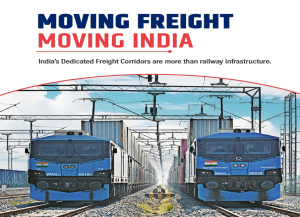
The completion of the Western DFC also completes the two great dedicated freight arteries—the 1,337-km Eastern DFC and the 1,506-km Western DFC—creating a ‘2,843-km dedicated freight network’.
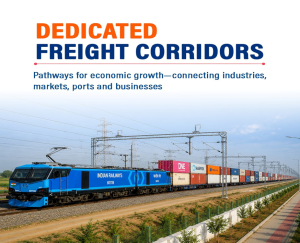
Its significance extends far beyond the movement of goods. As freight progressively moves to dedicated corridors, valuable paths are released on the conventional railway for passenger services, while ports, industrial centres, mines, production centres and markets receive faster and more predictable freight connectivity. This achievement therefore provides an appropriate moment to look farther ahead. What kind of railway network will India require in 2050—and in 2075?
Railways cannot be planned only after demand has arrived. An alignment created today may serve the country for a century or more. Some of the busiest arteries of Indian Railways still follow routes surveyed and constructed more than 150 years ago. When India First Built for the Future There is a remarkable lesson in our own railway history. India’s first passenger train travelled just 21 miles from Bombay to Thane in 1853, but within the first forty years the network had expanded to roughly 18,500 miles—an average geographical expansion of about ‘460 miles, or 740 kilometres, every year for forty years’. The comparison with the post-Independence period is interesting. Indian Railways had 53,596 route kilometres in 1950–51 and about 69,000 kilometres today, an average geographical expansion of roughly ‘214 route kilometres annually’.
Independent India has, of course, invested enormously in gauge conversion, electrification, doubling and multiple-lining, stronger track, signalling and capacity enhancement of the inherited network. The two eras cannot be compared mechanically. The point is to recall the scale of geographical expansion once undertaken, and the scale of thinking that a rapidly growing India may again require.
Even the legal framework evolved with the arrival of the railway Act XLII of 1850 brought Government-sanctioned railways within the framework for acquisition of land for public works; Bombay enacted provisions for railway land in the same year, Madras followed in 1852, and a more general land-acquisition framework emerged in 1857.
Modern India rightly operates under entirely different safeguards, but the planning lesson remains relevant: *infrastructure, land policy and institutional mechanisms have to move together when a country builds for generations ahead.* What the Roads Have Demonstrated Post-Independence India itself provides a striking demonstration of what sustained infrastructure creation can achieve. From about *4 lakh kilometres in 1951, India’s road network has expanded to 63.73 lakh kilometres*. National Highways alone have grown from 91,287 kilometres in 2014 to about *1,46,572 kilometres by March 2026*, accompanied by a remarkable expansion of four-lane highways, access-controlled corridors and expressways. This transformation has connected villages with markets, cities with their hinterlands and industrial centres with ports. The comparison need not be rail versus road. Rather, the expansion of roads demonstrates the scale at which infrastructure can grow when capacity is created continuously in anticipation of economic and social demand.
A similar long-range approach to railway capacity can complement this remarkable achievement. Follow the Geography of Growth India’s economic geography is increasingly concentrated around powerful urban and industrial centres. It’s ‘47 million-plus cities contribute around 60 per cent of the country’s GDP’.
Connecting these engines of growth through fast, frequent and affordable railways is therefore much more than a matter of passenger convenience; it is part of the economic infrastructure that sustains their growth. That connectivity must increasingly be planned around *two great flows—people and materials*. As employment expands in manufacturing, construction and services, millions of workers will continue to move between their home regions and cities where opportunities are created. For them, railway capacity must mean not only speed, but adequate, dependable and affordable travel. A growing economy must be able to move its workforce efficiently between regions of labour supply and regions where employment is expanding. The other flow is equally important. Growing cities and industries require coal, iron ore, steel, cement, foodgrains, automobiles, containers, components and countless other commodities moving from mines, farms, factories and ports across the country. The railway network of the future must therefore connect not only *city to city, but people to employment, raw materials to industry, factories to markets and production centres to ports*. Capacity for Fifty Years The railway map reveals an equally striking concentration of traffic. The seven High-Density Network corridors constitute only about ‘16 per cent of the railway network, yet carry roughly 41 per cent of its total traffic’.
These are not merely busy railway lines; they are economic arteries connecting many of India’s largest cities, industrial regions, ports and markets. Modern signalling, automatic train protection and better operating practices can extract considerably more capacity from existing infrastructure and must continue to advance. But as traffic grows, physical capacity must grow with it. Sometimes the answer to another train must be another line.
The busiest corridors should therefore be examined not merely for what they will require five or ten years from now, but for what they may carry ‘fifty years hence’. Depending upon future demand, this could mean third and fourth lines, additional pairs of tracks, bypasses around major cities, further dedicated freight corridors or, on exceptionally dense inter-city sectors, dedicated passenger corridors. More importantly, these cannot be planned in isolation. A railway is a system. The main corridor, feeder routes, junctions, terminals, ports, industrial sidings and the conventional passenger network must be planned together, because the capacity of the whole ultimately depends upon how efficiently its different parts work together. Land for Tomorrow’s Railway This brings us to perhaps the most difficult resource of all—land. The most difficult railway land to acquire is often the land sought after cities, industries, highways and settlements have already grown around a proposed alignment. A corridor identified twenty or thirty years in advance can be protected far more intelligently than one identified only when additional capacity becomes urgently necessary.
India could therefore prepare a *Railway Capacity Map for 2075*, identifying the corridors likely to require substantial additional capacity over the next fifty years. This does not mean constructing every line immediately. It means forecasting the movement of people and commodities, identifying future alignments, integrating them with urban, industrial, port and logistics plans, and protecting critical corridors before development makes them prohibitively difficult or expensive. Such a map should not remain static. It could be reviewed periodically as population, industry, technology and patterns of trade change, while preserving the essential principle that railway capacity must be created *ahead of demand rather than in response to congestion*.
Rail and Road—Partners in Growth India needs both road and rail. Roads provide extraordinary flexibility and indispensable first- and last-mile connectivity; railways can move very large numbers of passengers and enormous volumes of freight efficiently over long distances. An integrated transport system allows each mode to perform the task for which it is best suited. The Dedicated Freight Corridors demonstrate what can happen when railway capacity is created deliberately and on scale. India today possesses engineering capability, technology, financial strength and project-management tools that the railway pioneers of the nineteenth century could scarcely have imagined.
The present thrust on railway infrastructure gives us the opportunity to think on a scale commensurate with the India that is emerging. The next phase should connect our great growth centres faster and more affordably, provide dependable mobility for the millions who travel in search of opportunity, carry the raw materials and goods on which those centres depend, create additional capacity on our great trunk routes, and reserve today the corridors that future generations will need. Railways have always been built for a future larger than the present. The lines laid during the nineteenth century continued carrying an India their builders could scarcely have foreseen. The decisions we make today will similarly shape the movement of people and goods long after 2050. *We should not build the railway that India needs when the traffic arrives. We should build the railway that allows that India to arrive.
( The author, P. K. Mishra is a former General Manager of Indian Railways and a senior officer of the Indian Railway Service of Mechanical Engineers (IRSME), with four decades of experience in railway policy, operations, manufacturing and system transformation. As General Manager of Modern Coach Factory, Raebareli, and Rail Coach Factory, Kapurthala, he was closely associated with the manufacture of Vande Bharat coaches. He is the author of *Rail Through Raj: The East Indian Railway (1841–1861)* and writes on railway history, policy and the future of Indian Railways.)

Advertisement:
















Add Comment