



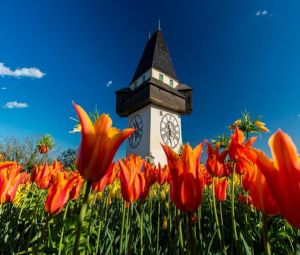
(Uhrturm in Graz)
BY INDER RAJ AHLUWALIA
NEW DELHI | 7 MAY 2026
A 900-year old history isn’t something to be trifled with, and sure enough, it’s a city with many stories to tell.
At the pinnacle of its glory in medieval and Renaissance times, Graz was the seat of the Hapsburg monarchy. The Old Town, one of Central Europe’s best preserved city centres, was recently included in the UNESCO world cultural heritage sites. And the city itself was identified as Europe’s Cultural Capital 2003.
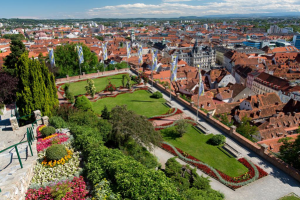
( Schlossberg in Graz)
A Mediterranean atmosphere, hidden courtyards, and Renaissance buildings: a hint of romance tinges the scenario. There are stunning contrasts: tradition and modernism; classical music and jazz; literature; and festivals like the ‘styriarte’ and the ‘steirische herbst’. And there’s also a scholastic tale, this being an educational centre of repute since 1585, its university today boasting Europe’s only jazz faculty.
My first sight of the Schlossberg with the Clock Tower – a 474 metres high green hill that saw early activity and attracted settlement by the Celts and Romans – set the tone rather nicely. Built in the Middle Ages, the mighty fortress was destroyed by Napoleon in 1809, with the most impressive remnants now being the Clock Tower and the casements – restored and ingeniously converted into an open-air theatre. Hidden inside the Schlossberg are two architectural gems: the spectacular Schlossberglift, which gets you up to the Clock Tower within seconds; and the ‘Dom im Berg’, a 500 metre underground exhibition room.
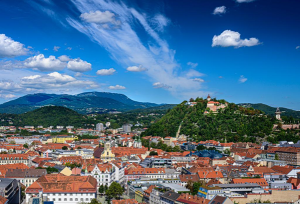
(( Panorama View City Graz)
With its characteristic wooden gallery, and old bells dating back to 1382, the Clock Tower has been ticking away over Graz since 1712. Dominating everything, it’s the city’s most famous landmark, emblem and symbol of its romantic flair, the traditional place for couples to have their first kiss.
I moved on. Situated next to the Landhaus, the Provincial Armoury displays over 30, 000 exhibits, the world’s largest historical collection of weaponry, preserved here since 1551. An assortment of swords and guns that had done duty in troubled times lay before me as I did the rounds of the armoury.
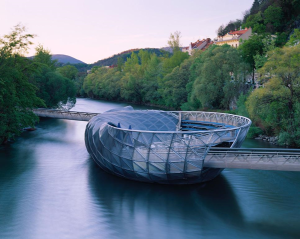
( Mur Island in Graz)
My next port of call was the town’s undisputed Italian Renaissance masterpiece, the Landhaus with its beautiful arcaded courtyard. Built by Italian architect Domenico dell’Allio in the 16th Century, the Landhaus today provides the perfect backdrop for regular concerts and open-air performances.
The centre of the main square is dominated by a fountain commemorating Archduke Johann, the ‘Styrian prince’, who founded the provincial museum Joanneum. To the south of the main square with its market stalls lies the Town Hall, the third town hall to stand on this spot.
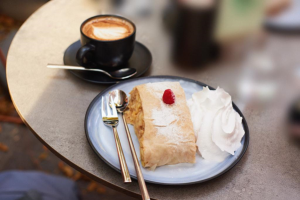
( Apple Strudel in Graz)
A stroll brings ample rewards. Sackstrasse has numerous antiques shops awaiting your visit. On the corner of the Schlossbergplatz stands the baroque Palais Attems, an architectural jewel housing the offices of the music festival ‘styriarte’. Narrow and steep, the Sporgasse, one of the town’s most romantic and idyllic streets, winds its way up along the foot of the Schlossberg. The picturesque courtyard of No 22, the House of the Teutonic Order, paved with the so-called ‘Murnocklein’ stones from the river Mur, merits a stop.
Definitely worth stopping by at is Hofgasse! A real gem is the hundred-year old sculpted façade of the court bakery Edegger-Tax, with its beautiful inlaid woodwork. Since 1569, this family-run bakery has been offering its traditional Styrian specialties as gastronomic temptations.
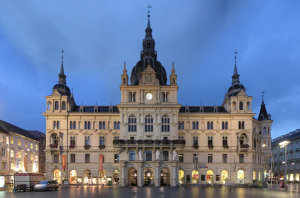
(Rathaus, City Hall in Graz, Austria)
Monuments of great character embellish the town. The Gothic Cathedral built by Emperor Frederick 111 was to serve as a city parish and court church. The mausoleum built by Italian architect Pietro de Pomi for Emperor Ferdinand 11, dates back to 1614. Together with the Burg; the Schauspielhaus; and the old Jesuit college, they form the so-called ‘city crown of Graz’. The Burg is today the seat of the Styrian provincial government, with a somewhat hidden treasure in the form of the 1499, late Gothic double winding staircase, a marvel of medieval stonework.
Planned by Europe’s most famous theatre architects of the time, Helmer and Fellner, the opera house was built in 1899, and features tradition meeting modernism in the form of the ‘light sword’ by Hartmut Skerbisch.
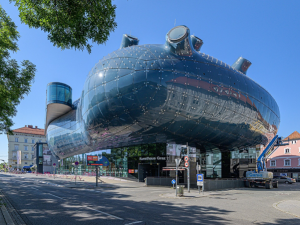
(Graz Art Museum)
An absolute must-see is Schloss Eggenberg, the most splendid palace in the province, built in 1625 in the style of mannerism, its interior lavishly decorated in baroque and rococo styles. You can see a different view for each day of the year by looking through the symbolic 365 windows.
For centuries, farmers have been taking their produce to the colourful markets at Lendplatz and Kaiser-Josef-Platz, and visitors today see a whole range of specialties on offer, including the famous pumpkin-seed oil, Styria’s black gold.
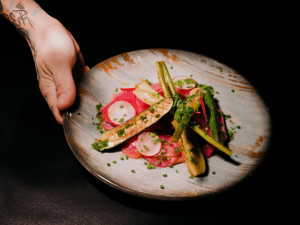
( Credit all photo of Graz – Austria Tourism)
A tour of Styrian cuisine is a joyous experience and Graz is rather well-endowed in the culinary department. For a substantial snack, try the specialties of the traditional Graz fast-food restaurant, the Wurstelstand (sausage stand) whose menus feature Debreziner, Burenwurst or Krainer. For really hearty eating, opt for specialties like the Wurzelfleisch (cooked pork with vegetables; Sterz (polenta); Backhenderl (crispy deep fried chicken); and a salad with Kurbiskernol (pumpkin seed oil). All this can be washed down by Styrian white wines like Welschriesling and WeiBburgunder or with a rosy Schilcher wine from West Styria.
After-dark action can be fairly racy. There’s the casino, located near the Landhaushof. But the centre of nightlife is the Bermuda Triangle – Farberplatz, Mehlplatz, and Glockenspielplatz, which is literally overflowing with bars and cafes, and becomes a large bustling beer garden on warm summer nights.
Unfolding its charms a little at a time, Graz had grown on me. I was impressed. And just a bit sorry to leave.
The Facts:
Graz is an hour by train and two hours by road from Vienna.
The vast accommodation network includes deluxe, standard and budget hotels.
A standard meal for two costs from Euro 40-60.
Though much of the tourist area is accessible on foot, you need a taxi or tram to see the entire city.
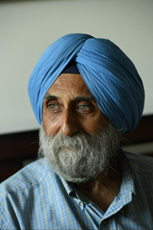
(Inder Raj Ahluwalia)
( THE WRITER IS AN INTERNATIONALLY RENOWNED , MULTIPLE AWARD – WINNING TRAVEL JOURNALIST AND AUTHOR)

Advertisement:







Add Comment