





TTT NEWS NETWORK
NEW DELHI | 26 AUGUST 2026
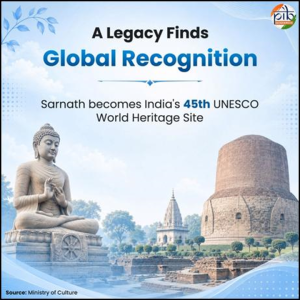
India’s rich cultural heritage has gained another global recognition with the inscription of the Ancient Buddhist Site of Sarnath on the UNESCO World Heritage List at the 48th Session of the World Heritage Committee in Busan, South Korea. As the place where Lord Buddha delivered his first sermon, Sarnath is one of the four principal Buddhist pilgrimage sites associated with his life. The inscription takes India’s tally to 45 UNESCO World Heritage properties, placing the country sixth globally and second in the Asia Pacific region. It also reinforces India’s identity as the birthplace of Buddhism and its commitment to preserving heritage of Outstanding Universal Value.
A Milestone for India’s Heritage
Heritage is more than a reminder of the past. It shapes the present and guides the future. It reflects the stories, traditions, and values that communities preserve and pass on across generations. Cultural and natural heritage are irreplaceable sources of identity, knowledge and inspiration.
On the evening of 25 July 2026, at the 48th Session of the World Heritage Committee in Busan, South Korea, the Ancient Buddhist Site of Sarnath was inscribed on the UNESCO World Heritage List. With this inscription, India now has 45 World Heritage properties recognised by UNESCO.
This recognition is more than a new entry on the World Heritage List. It celebrates India’s rich cultural legacy, shaped by diverse traditions, remarkable architecture and a long history. It also reinforces the spirit of the World Heritage Convention, which seeks to protect places of Outstanding Universal Value for the benefit of present and future generations across 196 States Parties.
The United Nations Educational, Scientific and Cultural Organization, better known as UNESCO, promotes the identification, protection and preservation of cultural and natural heritage that holds exceptional value for humanity. This commitment is rooted in the Convention concerning the Protection of the World Cultural and Natural Heritage, adopted by UNESCO in 1972.
As of July 2026, UNESCO’s World Heritage List carried 1,273 properties across 173 countries, comprising 991 cultural, 240 natural and 42 mixed sites. As of October 2024, 196 States Parties have ratified the World Heritage Convention making it one of the most celebrated and acknowledged conventions by any United Nations Agency.
The idea of World Heritage is unique because it extends beyond national boundaries. While these sites remain within the territories of individual countries, their significance belongs to all humanity. They are recognised as a shared legacy that deserves collective care and protection for generations to come.
The Sarnath Story
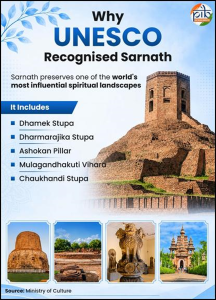
Sarnath holds a special place in Buddhist tradition. Located in Varanasi, Uttar Pradesh, it is one of the four key sites of Buddhist pilgrimage. The UNESCO World Heritage inscription covers two connected components: the Chaukhandi Stupa and the Archaeological Remains of Sarnath. The archaeological complex includes the Dhamek Stupa, Dharmarajika Stupa, Mulagandhakuti Vihara, the Ashokan Pillar and several other ancient remains. Together, they preserve the historic landscape of this ancient site.
Known in Buddhist tradition as Rishipatana, Ishipatana and Mrigadava, Sarnath is the place where Gautama Buddha delivered his first sermon in the 6th century BCE. This sermon, known as Dharmachakra Pravartana or the “Turning of the Wheel of the Law”, marked the beginning of the Buddhist Sangha and the establishment of the principles of the Noble Eightfold Path.
Over the centuries, Sarnath developed through royal, monastic and lay patronage. Numerous stupas, temples and viharas were constructed around the place associated with Buddha’s first sermon and his meeting with his first five disciples. The site reflects nearly sixteen centuries of continuous development. Its monuments date from the pre Mauryan period of the 4th-3rd centuries BCE to the 12th century CE, when Sarnath declined and was destroyed. The site remained obscure until its rediscovery in the 18th century.
The Road to Recognition
Sarnath’s journey to World Heritage recognition has been a long and careful process. The ancient site was included in India’s Tentative List of World Heritage in 1998.
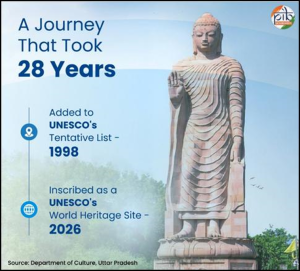
The proposal for its inscription was submitted for consideration by the World Heritage Committee in January 2025. This was followed by an eighteen-month long process involving technical meetings with UNESCO’s advisory bodies and an evaluation mission by ICOMOS to review the worthiness of the proposed property. ICOMOS, acting as one of the advisory bodies of UNESCO, provides evaluations of cultural and mixed properties proposed for inscription. The process culminated in the historic decision taken at the 48th Session of the World Heritage Committee in Busan, South Korea.
The Ancient Buddhist Site of Sarnath was nominated under criteria (iii) and (vi) of the UNESCO World Heritage List (under the framework of the World Heritage Convention).
Criterion (iii) recognizes Sarnath’s enduring spiritual significance as one of the four principal destinations of Buddhist pilgrimage. This is reflected in the many religious buildings and monuments constructed and rebuilt at the site over the centuries.
Criterion (vi) recognizes Sarnath’s direct and tangible association with events in the life of the Buddha that hold outstanding significance for the Buddhist community. These include his first sermon and his meeting with his first disciples after attaining of the Sambodhi (enlightenment) at Bodh Gaya. The numerous structures built at Sarnath over the centuries reflect the continuing importance of these events, the Buddha’s teachings and the concept of Triratna.
The inscription also reflects the wider purpose of the World Heritage Convention. UNESCO seeks to preserve and promote heritage of Outstanding Universal Value for present and future generations.
Sarnath: A Global Legacy of Peace
Sarnath is far more than an archaeological site. It remains a global pilgrimage destination for Buddhists from Japan, Thailand, Sri Lanka, Myanmar, Vietnam, South Korea, Cambodia, Mongolia and many other countries. As one of the world’s most revered Buddhist pilgrimage centres, it reinforces India’s identity as the birthplace of Buddhism and serves as a bridge for cultural ties and international engagement with Buddhist nations.
With Sarnath’s inscription, three of the four principal Buddhist pilgrimage sites associated with the life of the Buddha are now included in the UNESCO World Heritage List. These are Lumbini in Nepal, the Mahabodhi Temple at Bodh Gaya in Bihar and Sarnath in Uttar Pradesh. They join other important Buddhist World Heritage sites, including Sanchi, Nalanda and Ajanta in India, Anuradhapura in Sri Lanka, Paharpur in Bangladesh, and Taxila and Takht-i-Bahi in present day Pakistan.
The recognition also reaffirms India’s commitment to protect Sarnath’s Outstanding Universal Value. The Government will manage tourism sustainably and prevent unplanned development within the buffer zone to preserve the site’s authenticity and integrity for future generations.
Enabling India’s Heritage Success
Behind every successful nomination lies years of institutional groundwork. India’s approach to World Heritage properties rests on close coordination between central agencies, State Governments, and international bodies.
Ministry of Culture
The Ministry of Culture leads India’s engagement with UNESCO on cultural matters. It implements India’s commitments under UNESCO’s cultural conventions and coordinates nominations for World Heritage Sites and Intangible Cultural Heritage elements. The Ministry also promotes international heritage protection standards and strengthens cultural diplomacy through UNESCO and international cultural cooperation.
Archaeological Survey of India
The Archaeological Survey of India (ASI) is the nodal agency for World Heritage related matters on behalf of the Government of India. It undertakes the conservation and maintenance of 3688 centrally protected monuments, including 28 World Heritage properties. Its work also includes enforcement of two legislations, namely, the Ancient Monuments and Archaeological Sites and Remains Act, 1958 and the Antiquities and Art Treasures Act, 1972 apart from providing visitor facilities such as drinking water, toilets, pathways and landscaping. Conservation and maintenance are carried out regularly, based on the needs of each monument and the availability of resources.

Advertisement:
















Add Comment